Join us on our journey towards renewable energy excellence, where knowledge meets innovation.

On 10 June 2026, with delivery starting 11 June, the Core Capacity Calculation Region introduced Advanced Hybrid Coupling in the European day-ahead market. It replaces Standard Hybrid Coupling on the borders between the Core region and selected neighbouring regions, covering the HVDC interconnectors from the Hansa region towards the Nordics as well as the Romania-Bulgaria and Poland-Lithuania borders.
Most of the coverage so far has been written for traders and modellers. That is understandable, since the change lives deep inside the market coupling algorithm. But the consequences reach the revenue line of renewable assets, particularly in Germany. This article explains what changed and what operators of wind, solar PV and BESS plants should watch in the coming months.



Until 10 June 2026, cross-border capacity between the Core region and its neighbours was reserved two days ahead of delivery, based on forecasts of cross-border exchanges. When those forecasts ran high, capacity sat unused and welfare was lost. When they ran low, system operators needed extra security margins to keep the grid safe. Either way, the capacity available to the market was fixed before the market ever ran.
Advanced Hybrid Coupling removes that forecast step. Each affected border is now represented by a virtual hub inside the flow-based market coupling, so exchanges on those interconnectors compete for scarce network capacity on equal terms with all other cross-zonal trades. Transmission capacity becomes an output of the market optimisation rather than an input fixed in advance. With the new virtual hubs, the Core flow-based calculation now spans 23 hubs instead of the previous configuration, which also means more network elements and constraints enter the daily capacity calculation.
Three effects stand out for asset owners and managers.
First, redispatch. Many of the network constraints newly included in the market process sit in northern Germany, exactly where congestion between wind generation in the north and demand in the south originates. Because the market coupling now sees these constraints directly, day-ahead outcomes should respect physical grid limits more often, which is expected to reduce redispatch volumes and costs compared with the old approach. For German operators settling under Redispatch 2.0, fewer and cheaper interventions would be a welcome development. Countertrading at the German-Danish border could also decline for the same reason.
Second, cross-border capacity and price formation. Data from the parallel run published in the JAO Publication Tool suggests that the feasible import and export range for Germany widens under the new methodology, since four interconnectors that were previously handled through forecast-based reservations are now modelled as virtual bidding zones (hubs). Hungary shows a wider feasible import range as well, while zones further from the affected borders, such as France, Austria, Czechia, Slovakia, Belgium and Slovenia, show little change. Please note that a wider feasible range is not a guarantee of higher flows. It describes what the market could do, not what it will do on any given day.
Third, flow rerouting around the Danish borders. The Danish bidding zones sit at the centre of the affected HVDC interconnectors, so some redistribution of flows between DE-DK1, DE-NO2, NL-DK1 and DK1-NO is plausible. For assets in or exposed to these zones, that can shift spreads and the pattern of import and export hours.
The transition adds complexity as well as capacity. A larger flow-based domain with more constraints can, in specific situations, bind the market more tightly rather than less. The parallel run also showed occasional data issues that triggered default flow-based parameters and temporarily reduced tradable capacity. The first weeks of live operation will reveal how much of the theoretical improvement materialises in actual flows and prices.
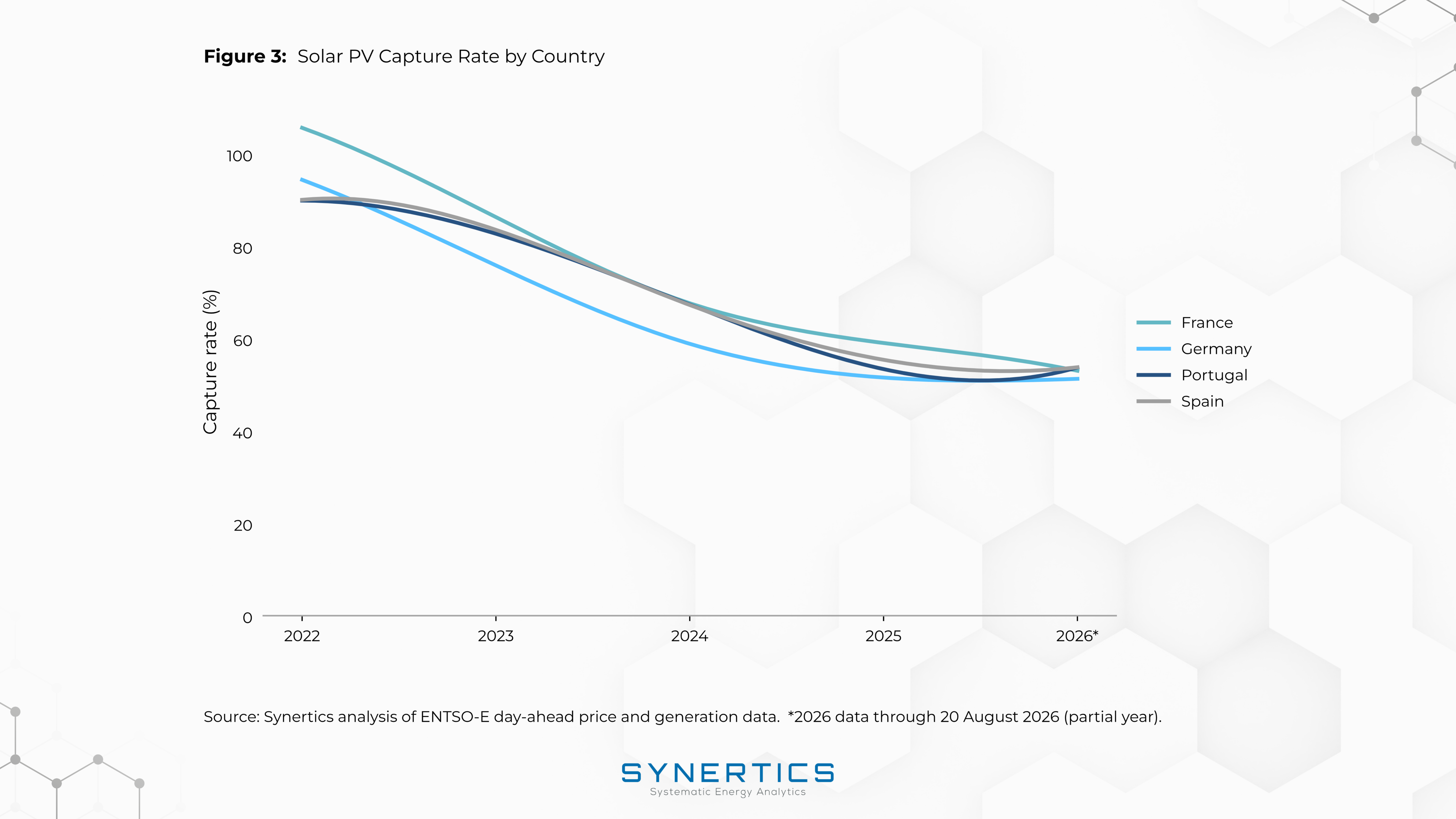
For operators with German, Danish or Central European exposure, the indicators worth following over the summer are capture prices in the affected zones, the frequency of negative price hours, redispatch volumes and costs in Germany and the evolution of spreads across the Danish borders. Movements in these metrics will show whether the promised welfare gains are arriving and where they land.
Market design changes of this kind rarely announce themselves on the revenue line until months later. Synertics tracks these drivers continuously across the markets we cover, so that operators can see what a change like this means for their own assets rather than for the system in aggregate. If you would like to discuss what Advanced Hybrid Coupling could mean for your portfolio in more detail, please let us know.

 5 min
5 min

Market-trends
1st Sep, 2026
5 min
Market-trends
24th Aug, 2026
5 min

Market-trends
6th Aug, 2026