
Join us on our journey towards renewable energy excellence, where knowledge meets innovation.

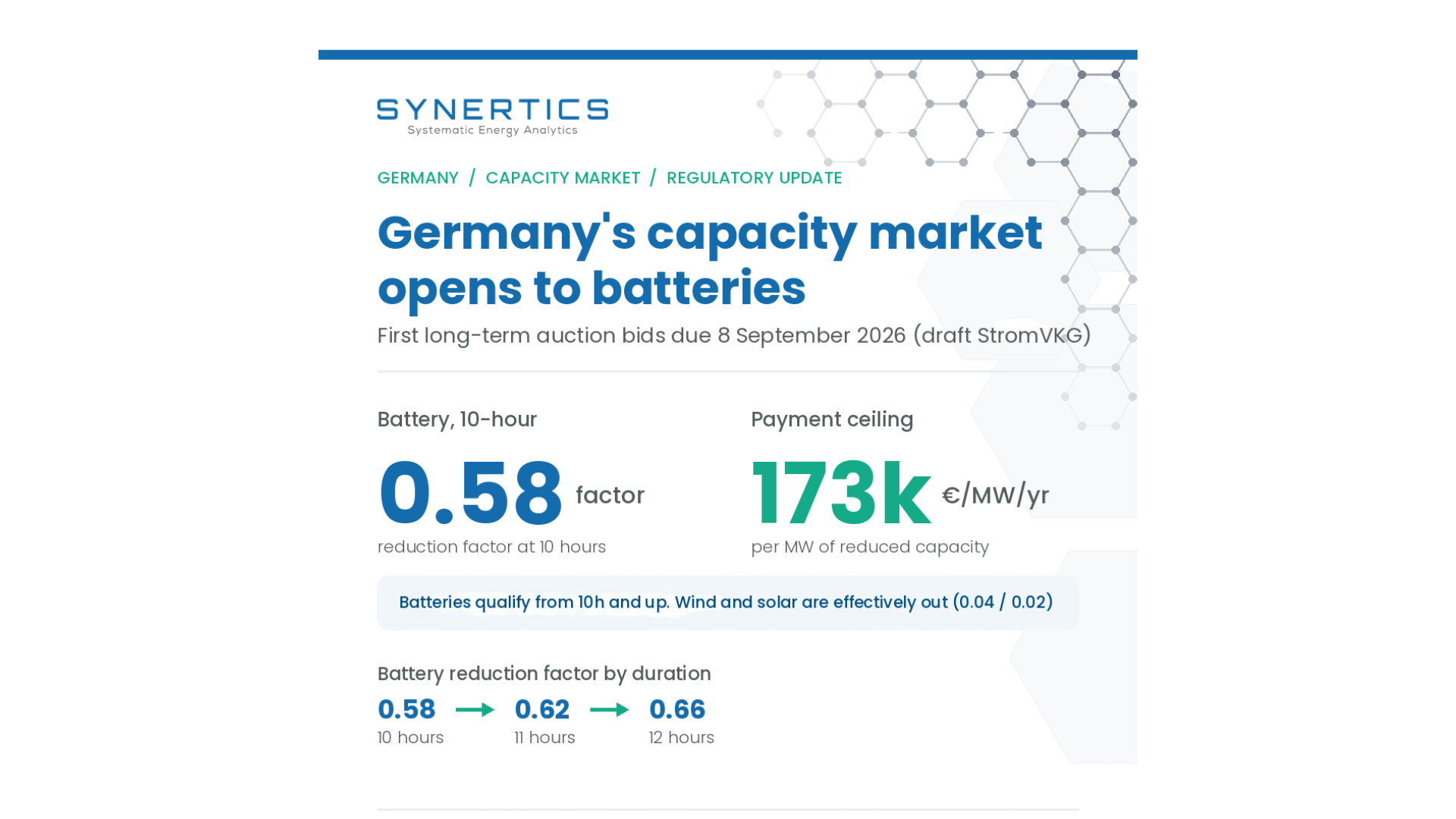
The Bundestag passed the Strom-Versorgungssicherheits- und Kapazitätengesetz (StromVKG) in its second and third reading on 9 July 2026. The Bundesrat cleared it the following day. That closes the legislative process Synertics flagged as a draft bill on 7 July, and it puts a hard date back on the calendar: the first two long-term capacity auctions are set for 8 September and 22 December 2026, 4.5 GW each, subject to state aid clearance from the EU Commission before either round can open.
What changed between the cabinet draft and the final text matters more than the passage itself for anyone holding or developing battery storage in Germany.



The original draft required batteries to deliver their full rated capacity repeatedly over ten-hour stretches with only a one-hour break in between, a requirement storage developers argued was closer to a stress test than a realistic operating profile. The law that passed swaps that for 80 percent of installed capacity, repeatable after a three-hour break. Requirements also now apply at the level of an aggregated asset pool rather than to each individual unit, which opens a cleaner path for portfolio and virtual storage participation.
A new reduction factor was also added for systems that can sustain output up to 24 hours: 0.89 for battery storage against 0.85 for gas plants at the same duration, per BSW-Solar's reading of the final text. Resilience and component-origin criteria were broadened too, applying evenly across renewables, storage and gas rather than setting a higher bar for storage specifically, and dropping the requirement that all named criteria be met simultaneously.
BDEW also points to a raised maximum bid value and a confirmed regional split for the long-term auctions: one third of capacity allocated to the grid-technical north, two thirds to the south.
Onshore wind and solar PV remain effectively locked out of the mechanism. The reduction factors carried over from the draft, 0.04 for wind and 0.02 for solar, stay in the final law, so this is a storage story, not a wind or solar one. BSW-Solar's own read is that the amendments are a real improvement but stop short of genuine technology openness between gas and storage.
The bigger open item is Brussels. BDEW is explicit that the September and December auction dates hold only if the European Commission grants state aid approval in time, so the law being final in Berlin is not the same as the mechanism being live.
For BESS developers and asset managers already modelling German revenue stacks, the practical shift is that a capacity-market contract is now a more workable fit alongside merchant and ancillary revenue, not a punitive availability obligation that effectively rules out co-optimisation. The pool-level rule in particular changes the calculus for aggregators and multi-site portfolios that could not previously meet a per-unit ten-hour test.
None of this replaces a proper revenue-stack analysis. The capacity payment still comes with a ceiling, no double-funding with other support schemes, and a clawback when power prices spike, terms that were already in the draft and remain in force. Whether a September or December bid clears above the cost of qualifying depends on the asset's duration, location relative to the new north-south split and how the capacity contract interacts with the rest of its revenue.
Synertics models these capacity, ancillary and merchant revenue stacks for battery storage assets across the markets we cover. To see how the revised StromVKG terms change the numbers for your own portfolio, try the PPA Tool at https://synertics.io/signup/ or reach out at info@synertics.io.

 3 min
3 min
Insights, Announcements
6th Aug, 2026
3 min
Insights, Announcements
6th Aug, 2026
4 min
Insights, Announcements
6th Aug, 2026