
Join us on our journey towards renewable energy excellence, where knowledge meets innovation.

The Bundesnetzagentur has set out how the auctions under the new StromVKG, the electricity supply-security and capacity act, will work. The overview came in a regulator webinar on 25 June 2026 and rests on the draft bill (BT-Drs. 21/6279) published on 8 June. The design still carries the caveats of a draft, but the timeline is concrete: bids for the first long-term capacity auction are due on 8 September 2026, with the announcement due about seven weeks before that.
The purpose is straightforward. Germany has worked off its old surplus through market exit and the coal phase-out, the renewable share is heading toward 80 percent by 2030, and the supply-security monitoring flags a gap in dispatchable capacity from 2030. The auctions are meant to be the investment signal for 2031, ahead of a full capacity market from 2032. For our audience the relevant question is narrower: where do batteries sit in this, and what are the terms worth.



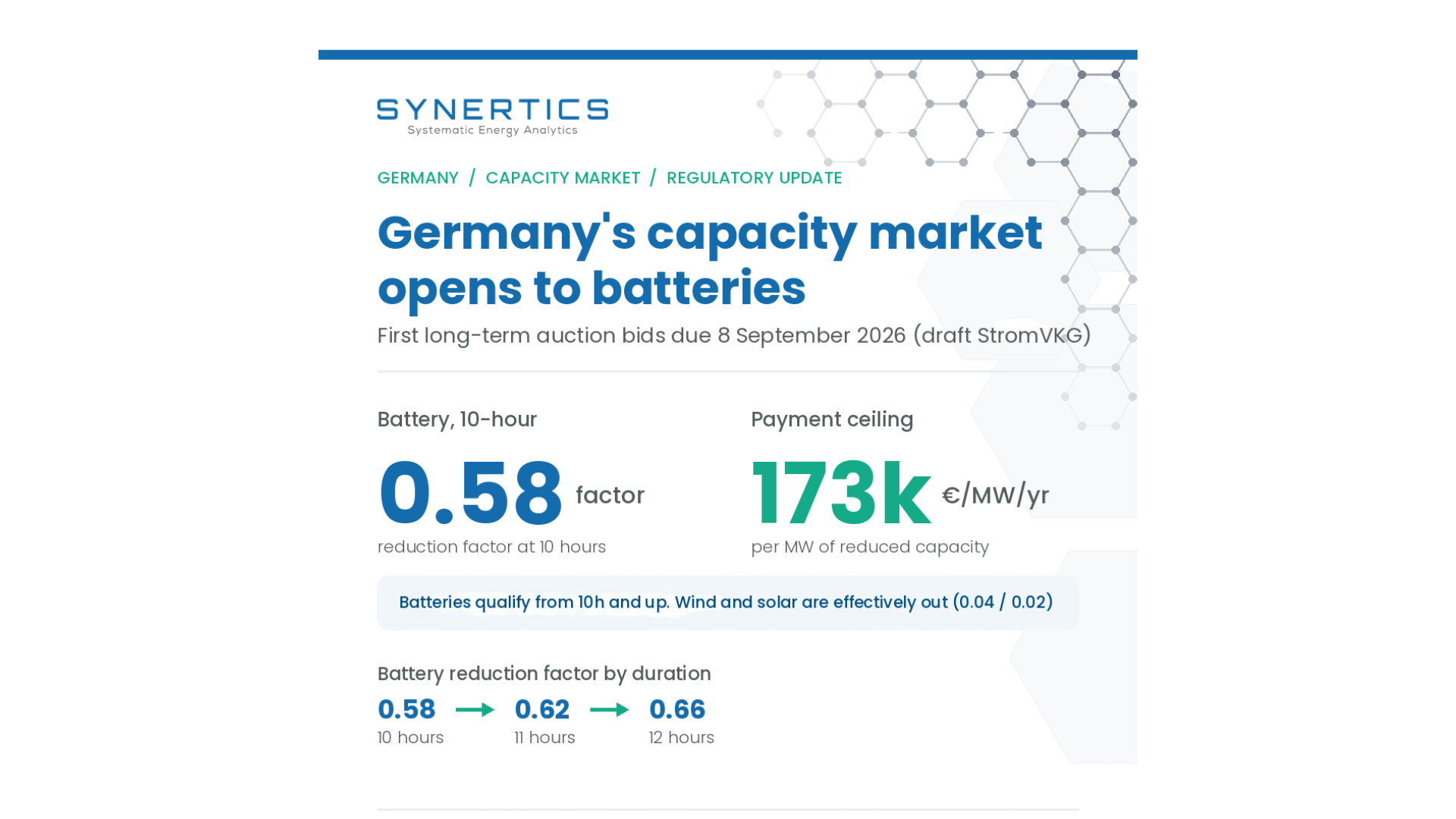
Eligibility runs through a reduction factor that scales nominal capacity down to the contribution a technology makes when the system is tight. That single number decides everything. Under the draft, onshore wind carries a reduction factor of 0.04 and solar PV 0.02, which removes them from these auctions in any meaningful way. Batteries, by contrast, are a named eligible technology, and pumped hydro sits alongside them.
So this is a storage story, not a wind or solar one. The design treats batteries as capacity providers, and it prices that capacity through duration.
The long-term capacity auction, the 9 GW segment that opens on 8 September, only admits energy-limited assets that can hold output for at least ten hours, and repeat that after a one-hour pause. For batteries the reduction factor rises with duration: 0.58 at ten hours, 0.62 at eleven, and 0.66 at twelve. Below ten hours a battery does not qualify for this segment, though the later "capacities" auctions, with bids from December 2027, drop the minimum-duration requirement and let shorter systems and controllable loads compete.
The practical read is that the near-term capacity money is aimed at long-duration storage, and shorter two to four hour systems will look to the later rounds rather than September.
For the long-term and generation auctions the ceiling is set in law at 173,000 euro per megawatt of reduced capacity per year, and the format is pay-as-bid. Because the payment attaches to reduced capacity, the reduction factor flows straight into the headline. A ten-hour battery derated at 0.58 could earn up to roughly 100,000 euro per nominal megawatt per year at the ceiling, before any competitive undercutting in a pay-as-bid round. The commitment runs for one, seven or fifteen years, with a minimum investment of 431,000 euro per reduced megawatt for the fifteen-year term and 201,000 for the seven-year term. Fifteen-year commitments above ten megawatts also carry an inertia obligation, which batteries can meet from their converter headroom.
Those are real numbers, and they are new revenue. The important point is what sits around them.
Two rules reshape the stack. First, there is no double funding: a battery that takes a StromVKG award cannot also draw EEG or KWKG support for the same asset. Second, the scheme carries a clawback, the Preisspitzenausgleich, that requires operators to pay back when the spot price runs above a daily strike price benchmarked to an open-cycle gas turbine, and it applies whether or not the asset actually produced in that hour. A global stop-loss caps the downside at twice the annual capacity payment, but the mechanism still trims the value of scarcity-hour arbitrage that batteries would otherwise keep.
For a storage business case that already blends wholesale arbitrage, balancing and ancillary revenue, the capacity payment is better read as a floor that changes the shape of the other streams, not as a clean addition on top of them.
The announcement lands around late July, prequalification runs through the transmission operators on a joint platform, and the fifteen-year commitments bring resilience, inertia and hydrogen-readiness conditions that need checking against a given project. Because this is still a draft, values such as the strike-price cost adder can move before the law is final. The decision for an operator is whether a ten-hour configuration and a multi-year availability commitment beat keeping the same battery fully merchant, once the reduction factor, the clawback and the no-double-funding rule are priced in for the specific asset.
That is an asset-level question, not a system-level one, and it turns on duration, location and how the capacity commitment interacts with the revenue you already model. Synertics prices these route-to-market and revenue-stacking choices across the markets we cover. To test a capacity bid against your battery's merchant and contracted revenue, try the tool at https://synertics.io/signup/ or reach out at info@synertics.io.

 3 min
3 min
Insights, Announcements
6th Aug, 2026
3 min
Insights, Announcements
6th Aug, 2026
4 min
Insights, Announcements
6th Aug, 2026