
Join us on our journey towards renewable energy excellence, where knowledge meets innovation.

On 29 June the Portuguese government put its National Energy Storage Strategy and the draft rules for two storage auctions out to public consultation. For anyone building or financing batteries in Iberia, this is the moment the market has been waiting for. Applications open on 14 September, which leaves a short and busy summer for developers who want to be ready.



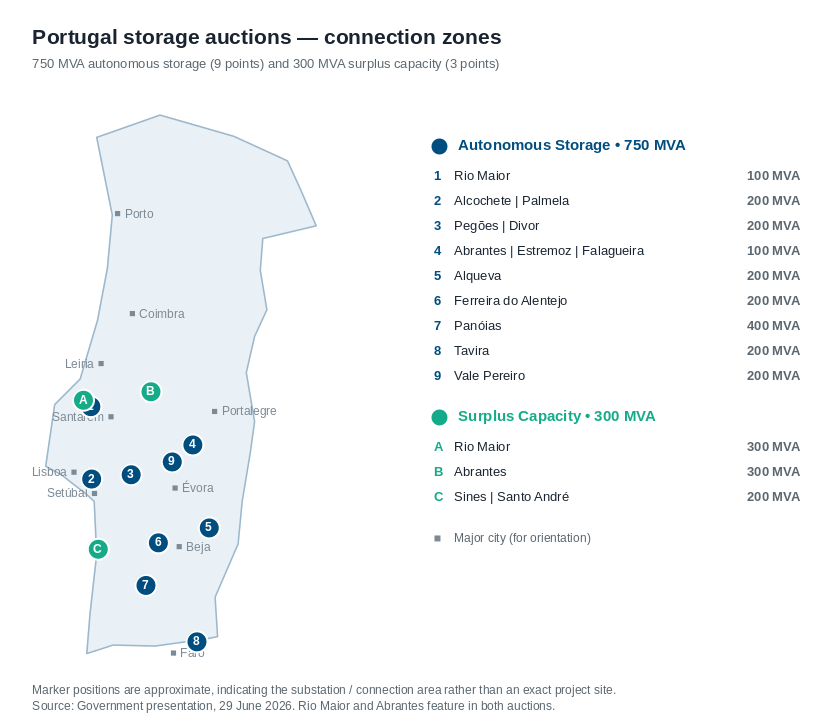
The government is running two parallel procedures. The first, Autonomous Storage, offers 750 MVA for standalone batteries across nine connection points, from Rio Maior in the centre to Tavira in the Algarve. The second, Surplus Capacity, offers 300 MVA for renewable plants that add colocated storage, across three points. Panóias stands out with 400 MVA of headroom, which matters because a point where demand exceeds the capacity on offer triggers a separate, more competitive location round.
This is the point that changes the calculus for developers. In Portugal the scarce resource is grid capacity, and this auction is how it is allocated. Winning a slot grants the reserve-capacity title, the right to connect a set number of MVA at a specific substation. There is no separate capacity application to the network operator beforehand. Bidders compete on price through an ascending clock that closes at a uniform price per MVA. Land control and connection scoping do not raise your score, but you need both to turn a win into a built asset and to avoid forfeiting the bond.
A battery in Portugal earns across several layers. Wholesale arbitrage is the core, charging through the midday solar trough and discharging into the morning and evening peaks, with intraday spreads that have topped 100 to 120 euros per MWh on recent days. On top of that sit the system services, all of them remunerated: the aFRR band and its energy; the mFRR energy today, with a daily band arriving in 2027; redispatch as well. The Portuguese system-services market reached around 1.35 billion euros in 2025, close to 40 percent of the day-ahead market, and it is growing. A capacity payment may sit above all of this, but it depends on the capacity mechanism that is still in EU state-aid pre-notification, and state-aid rules usually attach availability obligations and overcompensation controls, so it will top up market revenue rather than simply add to it.
Developers who want a credible bid have a full plate this summer: choose the target connection points, secure low-cost land options nearby, scope the physical connection with the operator, line up the qualification documents and bonds, then above all build the revenue model that sets a disciplined bid price. The winners will be the lowest-cost, best-financed bidders with the sharpest read on the revenue stack.
This is where Systematic Energy Analytics earns its name. Synertics gives operators live market intelligence across PPA, balancing, ancillaries and guarantees of origin in Europe, together with the tools to model the full revenue stack behind a storage asset, from arbitrage to system services. We currently support mandates covering more than 2.6 TWh across 14 countries. If you are weighing a Portuguese BESS project, we can help you turn the auction rules into a revenue case and a bid you can stand behind.
Start with SEMT at synertics.io/signup or reach out at info@synertics.io.

 3 min
3 min
Insights
19th Sep, 2026
3 min
Insights
11th Sep, 2026
2 min
Insights
3rd Sep, 2026